The Section 8 Housing Choice Voucher Program is one of the most widely used forms of Housing Assistance in the United States. This federal program, administered through Government Assistance channels, helps low income households afford housing in the private rental market. This article explains how the voucher program generally works and what applicants should know.
🎫 What Is the Housing Choice Voucher Program?
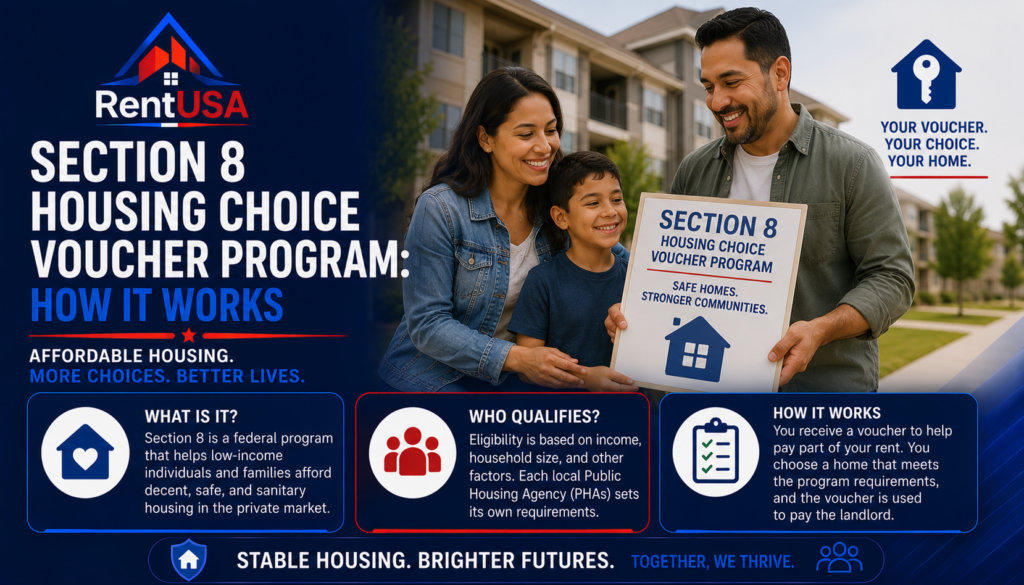
The Housing Choice Voucher Program, commonly known as Section 8, is a HUD-funded program that provides eligible households with a voucher covering a portion of their rent in privately owned housing. Unlike public housing, voucher holders choose their own housing on the open market, provided the unit meets program requirements and the landlord agrees to participate.
🎯 Purpose of the Program
Section 8 aims to give low-income households greater flexibility in choosing where to live, including access to neighborhoods with more employment and educational opportunities, while reducing the share of income spent on rent.
📋 Who May Qualify?
Income Requirements
Eligibility is based on household income compared to the Area Median Income, with priority often given to extremely low-income households.
Citizenship Requirements
Applicants generally must have U.S. citizenship or eligible immigration status.
Background Screening
PHAs may review rental history and other factors according to their specific administrative policies.
🏘️ How the Voucher Works
Once approved, a household receives a voucher and searches for housing in the private market. The local PHA pays a portion of the rent directly to the landlord, while the tenant pays the remaining portion, generally based on a percentage of their income. The unit must pass a housing quality inspection before the lease can begin.
📝 How the Application Process Generally Works
1. Apply Through the Local PHA
Applications are submitted to the Public Housing Authority serving the applicant’s area, and waiting lists may open only periodically.
2. Waiting List Placement
Due to high demand, most applicants are placed on a waiting list, which can take months or years depending on the location.
3. Eligibility Determination
When reached on the list, the PHA verifies income, household composition, and other eligibility factors.
4. Housing Search
Once issued a voucher, the household has a limited time to find a qualifying unit and landlord willing to accept the voucher.
5. Lease-Up and Inspection
The chosen unit must pass a Housing Quality Standards inspection before the lease and voucher payments begin.
📑 Documents Commonly Requested
Applicants are typically asked for identification, proof of income, Social Security numbers for household members, and rental history information.
⚠️ Common Reasons for Denial
Applications may be denied due to income exceeding program limits, unfavorable rental history, or failure to find a qualifying unit within the voucher’s search timeframe.
💡 Tips Before Applying
Applicants may benefit from applying to multiple PHAs where waiting lists are open, understanding local rent standards before searching for housing, and starting the housing search promptly once a voucher is issued, since search periods are time-limited.
❓ Frequently Asked Questions
Can I use a Section 8 voucher in any city?
In some cases, vouchers can be transferred between PHAs through a process called portability, though rules and availability vary.
Do all landlords accept Section 8 vouchers?
No. Participation is generally voluntary for landlords, though some state and local laws prohibit source-of-income discrimination.
Does receiving a voucher guarantee housing?
No. Voucher holders must still find a landlord willing to participate and a unit that passes inspection within the required timeframe.
Where Can You Learn More About This Program? 📌
If you would like additional information about this assistance program, eligibility requirements, application procedures, or current updates, you should consult the official source.
Learn more by visiting the official website: