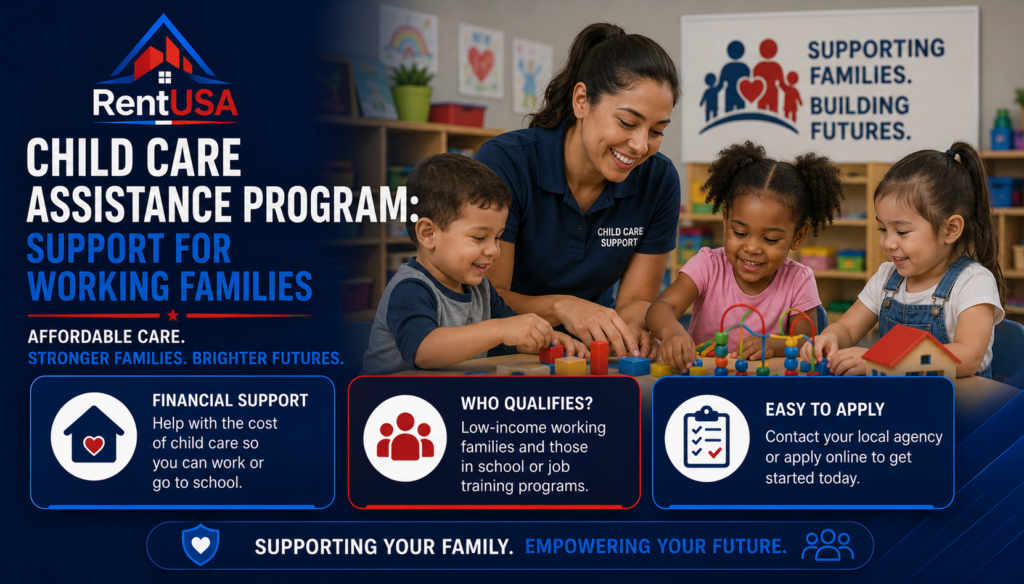
The Child Care Assistance Program helps low income working families afford quality child care. As part of broader Government Assistance and financial aid efforts, this program supports parents pursuing employment, education, or job training. This article explains how child care assistance generally works across the United States.
🧸 What Is Child Care Assistance?
Child care assistance refers to federal and state programs, primarily funded through the Child Care and Development Fund (CCDF), that help eligible families pay for child care while parents work, attend school, or participate in job training. States administer their own programs within federal guidelines, so eligibility and benefit levels vary.
🎯 Purpose of the Program
These programs aim to make quality child care more affordable, supporting parents’ ability to maintain employment or pursue education while ensuring children have access to safe, developmentally appropriate care.
📋 Who May Qualify?
Income Requirements
Eligibility is generally based on household income compared to a state-set percentage of the federal poverty level or state median income.
Activity Requirements
Parents or guardians typically must be working, attending school, or participating in an approved job training program to qualify.
Child’s Age
Assistance is generally available for children under age 13, or older in the case of children with special needs, depending on state rules.
💰 Benefits Offered
Support commonly includes subsidies paid directly to a licensed or approved child care provider, reducing the family’s out-of-pocket cost, and in some states, resource and referral services to help parents find quality child care options.
📝 How the Application Process Generally Works
1. Apply Through the State Child Care Agency
Applications are typically submitted through a state or local child care assistance office.
2. Provide Documentation
Applicants generally need proof of income, proof of work or school enrollment, and identification for household members.
3. Provider Selection
Families typically choose a participating licensed child care provider, which may include centers or approved home-based providers.
4. Ongoing Eligibility Reviews
Recipients are usually required to periodically confirm continued eligibility, including income and work status.
📑 Documents Commonly Requested
Applicants are typically asked for proof of income, proof of employment or school enrollment, identification for household members, and information about the child care provider.
⚠️ Common Reasons for Denial
Applications may be denied due to income exceeding state limits, not meeting the work or school activity requirement, or incomplete documentation.
💡 Tips Before Applying
Families may benefit from applying as early as possible since some states maintain waiting lists, confirming that their preferred child care provider participates in the program, and keeping documentation of work hours and income current.
🔗 Other Related Government Programs
Families receiving child care assistance may also want to explore related benefits such as SNAP, Medicaid, and TANF, which can further support household stability.
❓ Frequently Asked Questions
Can families in job training programs qualify for child care assistance?
Yes, many states extend eligibility to parents participating in approved education or job training programs, not just those who are employed.
Do families have to pay anything toward child care costs?
Many programs require a copayment based on income, meaning the subsidy typically covers a portion rather than the full cost of care.
Does eligibility guarantee an open child care slot?
No. Approval for a subsidy does not guarantee immediate availability at a specific provider, and some areas may have limited child care capacity.
Where Can You Learn More About This Program? 📌
If you would like additional information about this assistance program, eligibility requirements, application procedures, or current updates, you should consult the official source.
Learn more by visiting the official website: