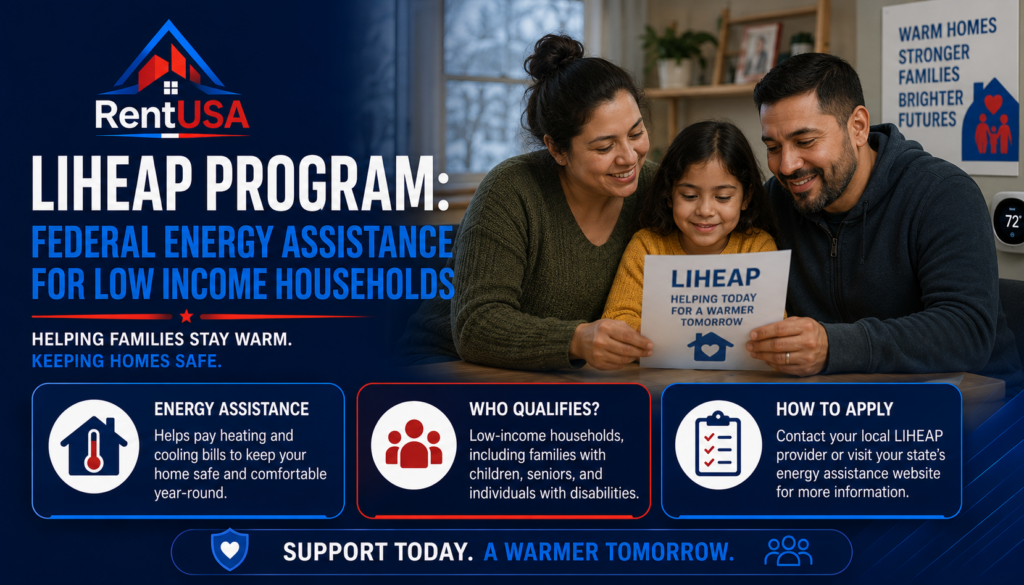
The LIHEAP Program offers essential financial aid to low income households struggling to afford home energy costs. As a key federal program within broader Government Assistance efforts, LIHEAP helps families manage heating and cooling expenses throughout the year. This article explains how the program generally works.
🔥 What Is LIHEAP?
The Low Income Home Energy Assistance Program (LIHEAP) is a federally funded program administered by states, territories, and tribal organizations to help eligible households pay for heating and cooling costs, address energy crises, and make minor home energy-related repairs.
🎯 Purpose of the Program
LIHEAP aims to reduce the health and safety risks associated with extreme temperatures by helping low-income households maintain access to heating and cooling, while also helping to prevent utility shutoffs.
📋 Who May Qualify?
Income Requirements
Eligibility is generally based on household income compared to federal poverty guidelines or a percentage of the state median income, with limits set individually by each state.
Household Vulnerability
Many states give priority to households with elderly members, young children, or individuals with disabilities or serious medical conditions.
Residency
Applicants must generally reside in the state or service area administering the LIHEAP funds.
💰 Types of Assistance Available
LIHEAP support commonly includes assistance paying heating or cooling bills, crisis assistance for households facing an imminent shutoff, and weatherization services in some states to improve home energy efficiency and reduce future costs.
📝 How the Application Process Generally Works
1. Identify the Local Administering Agency
LIHEAP is typically administered through state or local community action agencies rather than directly by the federal government.
2. Gather Documentation
Applicants generally need proof of income, a recent utility bill, and identification for household members.
3. Submit an Application
Applications are often available online, by mail, or in person, and typically open during specific seasonal periods.
4. Payment to the Utility Provider
Once approved, LIHEAP funds are usually paid directly to the household’s energy provider.
📑 Documents Commonly Requested
Applicants are typically asked for a copy of a recent energy bill, proof of household income, and identification for all household members.
⚠️ Common Reasons for Denial
Applications may be denied due to income exceeding state-specific limits, incomplete documentation, or exhausted funding for the current program year.
💡 Tips Before Applying
Households may benefit from applying as soon as the application period opens, since LIHEAP funding is often limited and distributed on a first-come, first-served basis, and from contacting their state’s LIHEAP office to confirm current income limits and required documents.
🔗 Other Related Government Programs
Households seeking energy assistance may also want to explore related benefits such as the Lifeline Assistance Program and utility bill assistance offered through local agencies.
❓ Frequently Asked Questions
Is LIHEAP available in every state?
Yes, LIHEAP operates in all states, territories, and many tribal organizations, though specific benefit amounts and application periods vary.
Can renters apply for LIHEAP?
Yes, renters who are responsible for paying their own utility bills may generally apply.
Does LIHEAP cover the entire energy bill?
Not necessarily. Benefit amounts vary based on household size, income, and available funding, and may only cover a portion of the total bill.
Where Can You Learn More About This Program? 📌
If you would like additional information about this assistance program, eligibility requirements, application procedures, or current updates, you should consult the official source.
Learn more by visiting the official website: